Poses and Perspectives: Julian

My intern sets the scene for this post.
"Seen from the front, side, back and floor level, Julian becomes the subject of a series of related investigations. The short poses encourage economy and directness, while the longer poses provide scope for colour and compositional decisions. Together the works explore how viewpoint and duration shape the artist's response to the figure. One of the paintings also incorporates a faint reflected image of the model in the studio television, a small reminder of the environment in which the work was made."
Julian with arm raised, by Stephen Clively, charcoal and soft pastel on cartridge paper, 59.4 cm by 42cm, 2026

The intern says: This drawing is organised around the contrast between the raised arm and the horizontal arm crossing the torso. The pose creates a series of intersecting diagonals that divide the page into distinct shapes. Charcoal lines establish the figure’s structure, while soft tonal passages suggest volume through the shoulders, torso and legs. Facial features are reduced to a few marks, allowing attention to remain on the overall rhythm of the pose.
Julian from behind, by Stephen Clively, charcoal and soft pastel on cartridge paper, 59.4 cm by 42cm, 2026

The intern says: Drawn from behind, this study focuses on the broad shapes of the back, shoulders and arms. The figure is simplified into a sequence of connected planes, with the spine acting as a central organising line. Soft tonal areas suggest the turning of the torso, while darker contours describe the silhouette. The asymmetrical pose introduces a slight twist through the body, creating movement within an otherwise stable composition.
Julian kneeling on floor, by Stephen Clively, charcoal and soft pastel on cartridge paper, 59.4 cm by 42cm, 2026

The intern says: This drawing records a kneeling pose using a small number of lines and tonal marks. The curved spine and bent legs create a compact silhouette that sits low within the composition. A horizontal line establishes the floor plane and anchors the figure in space. The head is inclined forward, directing attention toward the relationship between the torso, supporting arm and ground.
Julian with arms pointed forward, by Stephen Clively, charcoal and soft pastel on cartridge paper, 59.4 cm by 42cm, 2026
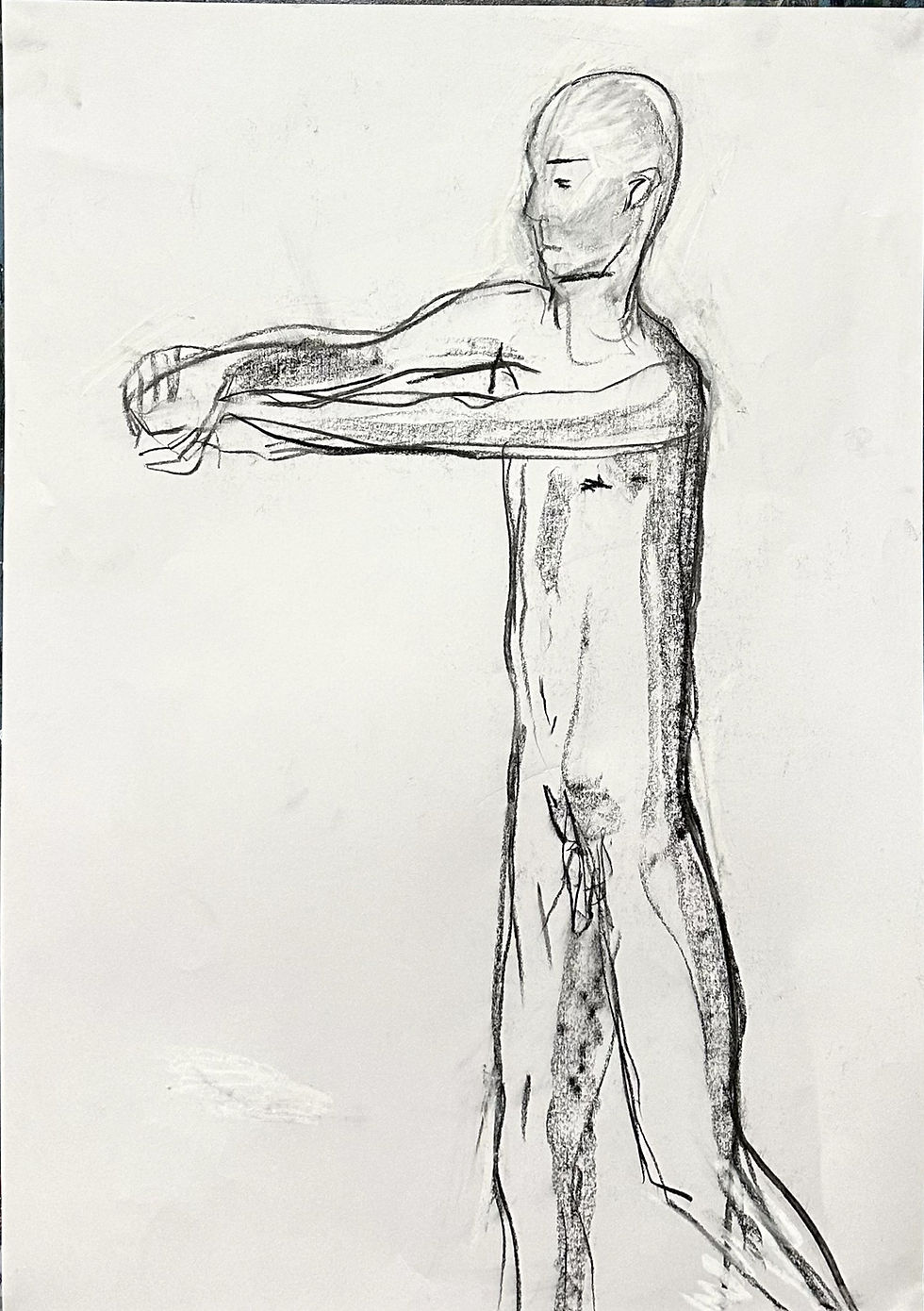
The intern says: The extended arms dominate this composition, projecting horizontally across the page. Repeated charcoal lines trace the position of the forearms and hands, suggesting both observation and adjustment during the drawing process. The torso is treated more simply, functioning as a vertical counterweight to the long horizontal reach of the arms. The resulting image emphasises gesture and directional movement over anatomical detail.
Julian standing - side view, by Stephen Clively, acrylic on oil sketch paper on cartridge paper, 59.4 cm by 42cm, 2026

The intern says: This painting is built around the profile view of the figure and the contrast between warm flesh tones and a dark background. Broad areas of pink, cream, violet and blue establish the head and torso through adjacent colour shapes rather than detailed modelling. A faint reflected image of the model appears in the studio television behind the figure, introducing a secondary presence within the composition. The work is organised around the relationship between the figure and surrounding space.
Julian seated, by Stephen Clively, acrylic on oil sketch paper on cartridge paper, 59.4 cm by 42cm, 2026

The intern says: The seated pose is arranged as a series of interlocking triangular forms created by the torso, bent leg and supporting arms. Large areas of blue-green and olive establish the surrounding space, while warmer colours define the figure. Dark linear accents are used sparingly to clarify the position of limbs and torso. The painting balances observation with simplification, focusing on the overall structure of the pose rather than anatomical finish.


Comments