Different Speeds of Looking (Lauren)

Updated: Jun 14
These sessions at my ASOC's Open Studio - Figure workgroup allow us to observe and depict the same model at different speeds. The drawings record rapid decisions, revisions and overlapping moments, while the paintings slow the process down and allow a single pose to be examined more fully.
The studies of Lauren move between one-minute sketches, layered drawings and forty-minute paintings, exploring how the experience of looking changes as time is compressed, accumulated or extended.
Lauren - two overlapping drawings, by Stephen Clively, charcoal, conte crayon and soft pastel on cartridge paper, 59.4 cm by 42cm, 2026
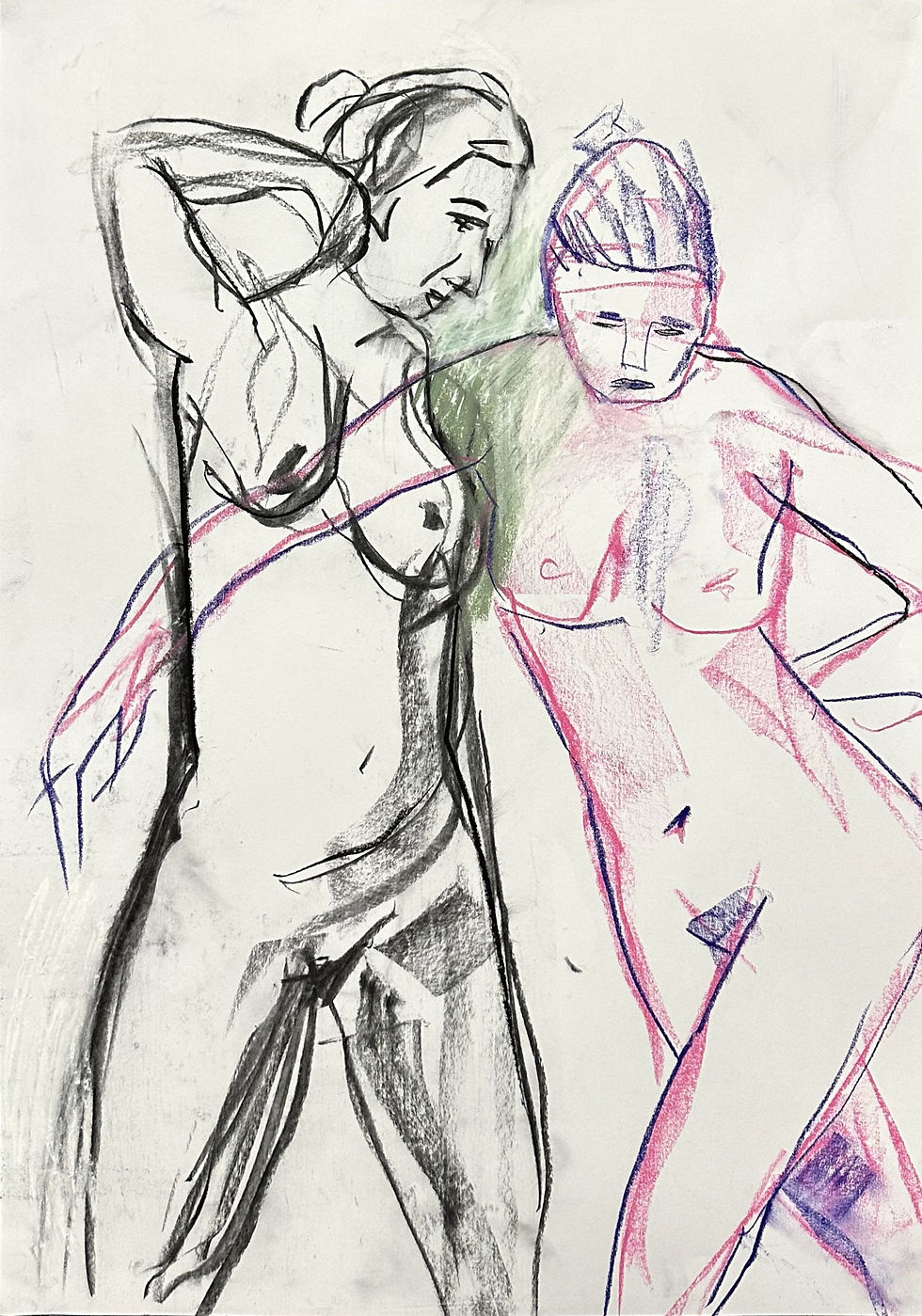
The intern says: Two standing poses share the same sheet, creating an image that oscillates between figure and transparency. The darker charcoal figure on the left carries greater weight and solidity, while the pink and blue conte drawing on the right appears lighter and more provisional. The two figures overlap at the shoulders and torso, creating a visual dialogue between the poses. Rather than depicting a single moment, the drawing records the passage of time, allowing successive observations of the model to remain visible simultaneously. The result has an almost Cubist sense of multiple viewpoints, although it remains firmly grounded in direct observation from life.
Lauren - three overlapping drawings, by Stephen Clively, charcoal and conte crayon on cartridge paper, 59.4 cm by 42cm, 2026

The intern says: Three separate poses occupy the same space, creating a dense web of lines, contours and shifting anatomies. Faces emerge and recede, limbs intersect, and the eye moves continuously between one figure and another. The layering creates an unusual balance between structure and ambiguity. Although individual poses can still be discerned, the drawing increasingly becomes about movement through time rather than description of the body. The overlapping forms generate a rhythm across the page that recalls the exploratory nature of rapid life drawing sessions, where observation must compete with memory and instinct.
Lauren - two overlapping drawings, by Stephen Clively, charcoal and conte crayon on cartridge paper, 59.4 cm by 42cm, 2026

The intern says: This work is more open and spacious than the other layered drawings. The principal standing figure remains largely intact, while traces of a second pose pass behind and through it. The coloured lines create a scaffold of movement around the more stable central form. There is an appealing tension between certainty and revision: some contours are confidently established, while others remain tentative and exploratory. The drawing demonstrates how successive poses can enrich rather than obscure one another, producing an image that is simultaneously descriptive and abstract.
Lauren - seated one arm raised, by Stephen Clively, charcoal and soft pastel on cartridge paper, 59.4 cm by 42cm, 2026

The intern says: Lauren is shown seated, one arm lifted above her head while the other drapes over the back of a chair. The drawing is built from a combination of firm charcoal contours and some broad passages of rubbed soft pastel. The raised arm creates a strong arc that guides the eye around the composition and frames the head. Rather than describing every anatomical detail, the drawing concentrates on the relationship between the major masses of the body and the chair. Areas of white pastel soften transitions and suggest volume, while the darker linear marks provide structure and definition. The result is a drawing that conveys both the stability of the seated pose and the slight tension introduced by the lifted arm.
Lauren - one leg kneeling on a chair, by Stephen Clively, conte crayon and charcoal and soft pastel on cartridge paper, 59.4 cm by 42cm, 2026

The intern says: This drawing presents a more dynamic arrangement. Lauren balances with one leg raised onto a chair, creating a composition of intersecting diagonals and asymmetrical forms. The dark charcoal background establishes a dramatic contrast against the lighter figure, pushing the body forward into the viewer’s space. Red and blue conte lines remain visible alongside the charcoal, creating a layered network of structural marks that trace the body's movement and construction. The pose conveys both strength and balance, while the simplified facial features and abbreviated anatomy keep the emphasis on gesture and overall design. The drawing demonstrates how a relatively short pose can still produce a convincing sense of physical presence through selective observation and confident mark-making.
Lauren reclining, by Stephen Clively, acrylic on oil sketch paper, 61 cm by 43cm, 2026

The intern says: Lauren reclines diagonally across the picture plane, her body occupying the boundary between a green upper field and a blue lower field. The composition is strikingly simple, built from large areas of colour and a small number of decisive contour lines. The pose creates a strong sense of movement across the vertical format, with the bent legs and tilted torso generating a dynamic rhythm. The flesh tones are warm and luminous against the cool background colours, while the facial features are reduced to essential marks that convey a quiet, reflective mood. The painting balances observation and abstraction, relying on broad colour relationships rather than detailed modelling to establish form.
Lauren reclining, by Stephen Clively, acrylic on oil sketch paper, 43 cm by 61 cm, 2026

The intern says: This reclining pose recalls a long tradition of figure painting, yet the treatment remains contemporary and direct. The figure is constructed through broad passages of colour and expressive brushwork rather than careful finish. Green and blue fields provide a simplified setting that allows the pale figure to dominate the composition. Areas of olive-green shadow move across the torso and limbs, creating a subtle interplay between the body and its surroundings. The painting conveys both repose and alertness, with the model's gaze and angled head preventing the composition from becoming static.


Comments